Welcome to British Regional Transport Association: Sustainable Britain Needs Re-Railing
Menu
Guildford – Cranleigh – Horsham
Strategically important, regionally and locally.
Lying dormant since the 60s, these Surrey and West Sussex rail corridors could provide important new links between Reading, Heathrow and West London to the South Coast.
rail Network capacity and resilience
Reconnecting communities, enhancing accessibility and inclusion
Reducing road congestion and pollution, improving our environment
promoting quality of life and health
Guildford – Cranleigh – Horsham
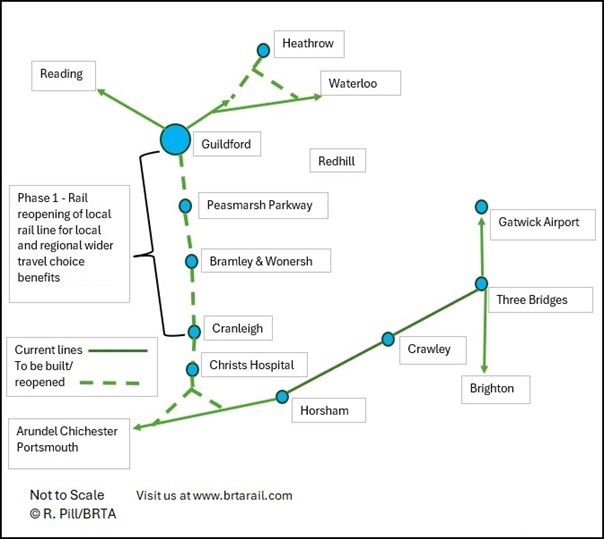
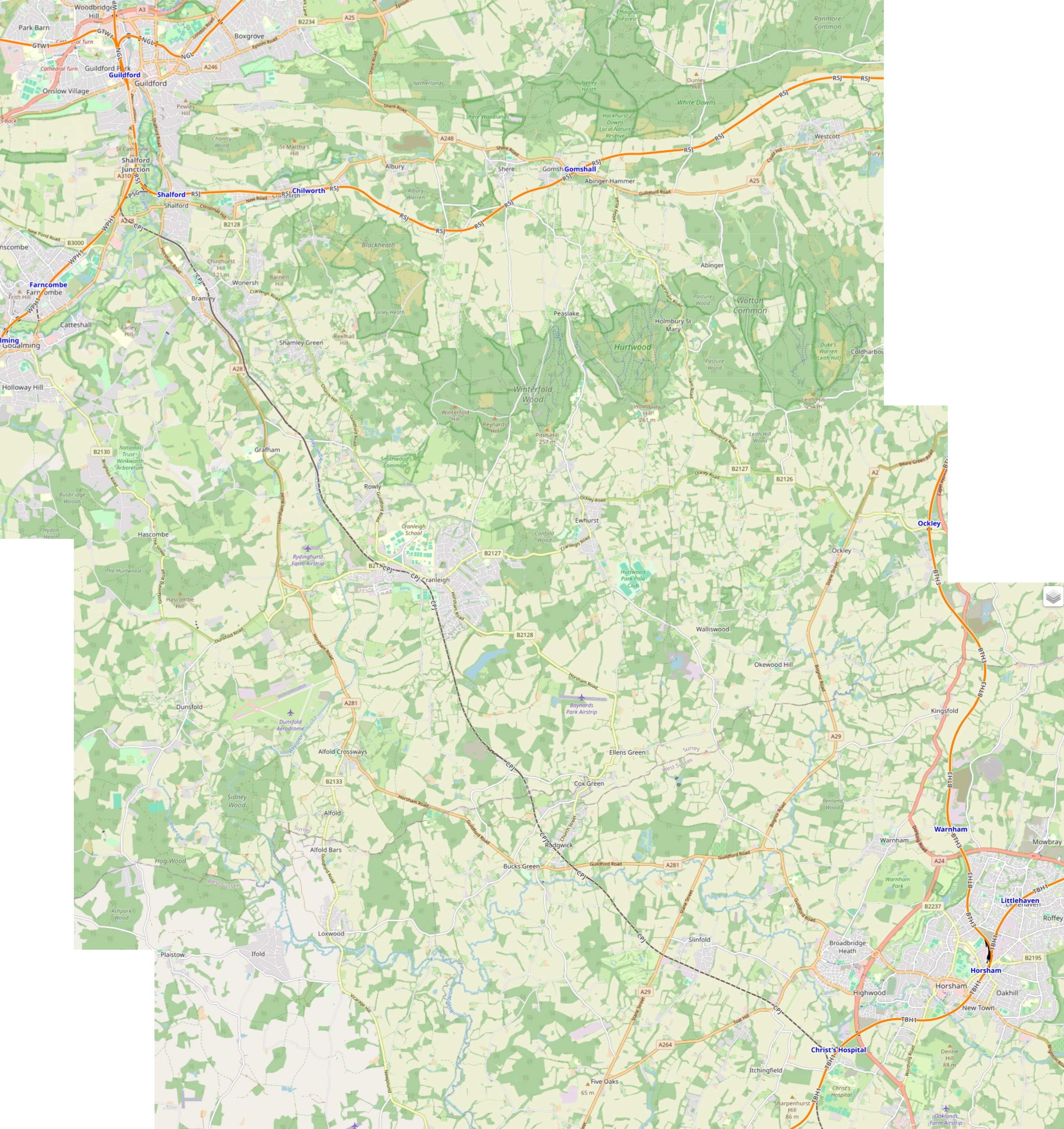
Our priority is to spotlight the 25km Guildford – Horsham “Cranleigh” line. It offers a huge opportunity to re-link many communities to the rail network and provide an artery for freight by rail fit for the 21st century.
…and South via Steyning?
Horsham – Shoreham-by-Sea
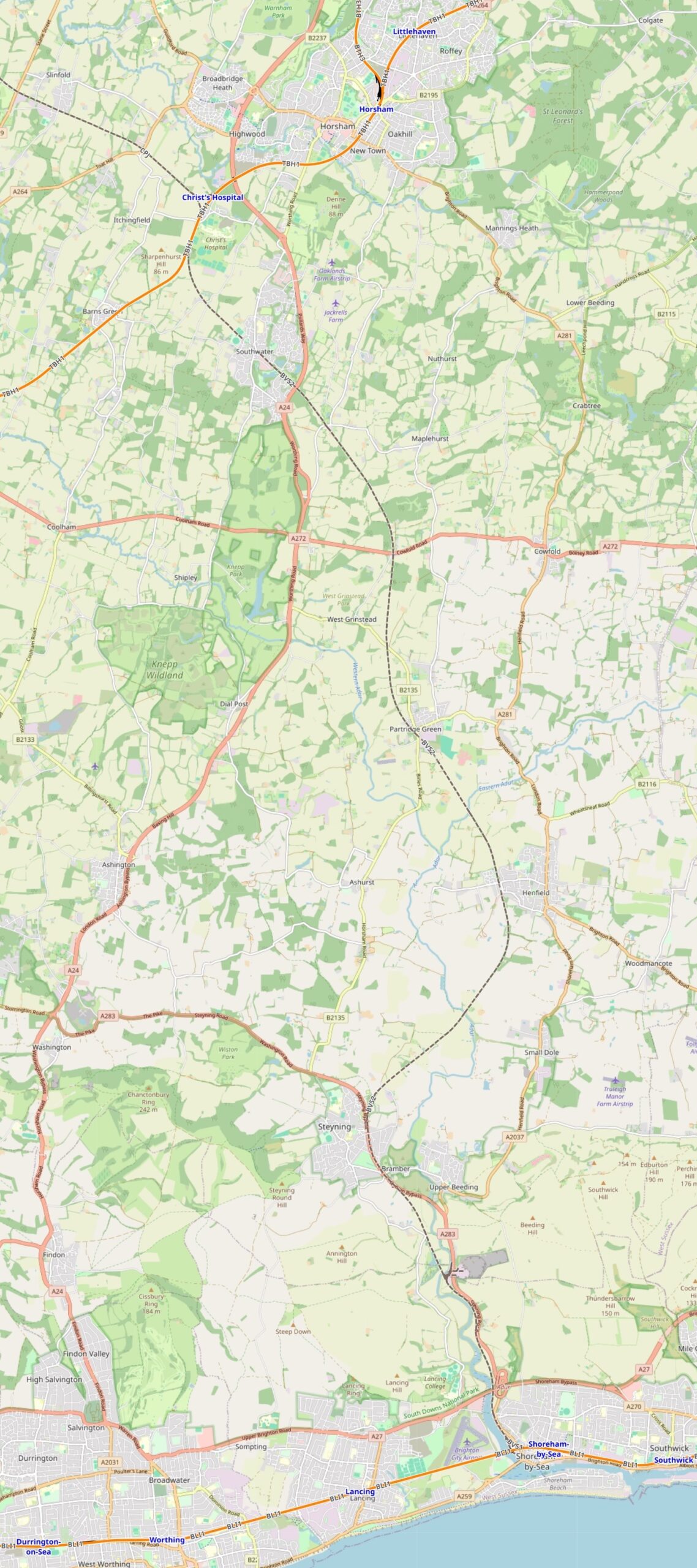
The 32km “Steyning” route, continuing from Christ’s Hospital south to Steyning and Shoreham-by-Sea, is a more ambitious re-opening project where more of the original route has been lost, yet we feel it must be considered and investigated as part of a progressive review of rail in the region.
Mapping by openrailwaymap.org
RE-RAIL FOR LOCAL AND REGIONAL CONNECTIVITY
Local commutes for populations of Guildford, Cranleigh and Horsham would be transformed and we anticipate that a profound pull to rail from road would follow.
A shuttle service linking Gatwick – Three Bridges – Horsham – Guildford – Heathrow would provide car-free access to airports for both leisure and business journeys and airport staff commuting.
Regionally important links would be created from Reading / Old Oak Common / Heathrow to Brighton via a new curve at Arundel Junction (or, one day, direct on to Shoreham-by-Sea). A secondary route from Reading and West London hubs to Chichester and Portsmouth would also be made possible.
The restored route would offer crucial relief to the Brighton Main Line, building rail capacity and reliability in the region.
High quality, fast and efficient through-journeys could be made from the South West and Swindon/Oxford lines via Reading, Guildford and on to the South East coast – completely bypassing London interchanges and junctions. The result would be speedier and more convenient journeys for passengers alongside cleaner, more efficient pathing for freight of all sizes by rail.
Mapping by openrailwaymap.org
IT’S ALL ABOUT THE CURVES
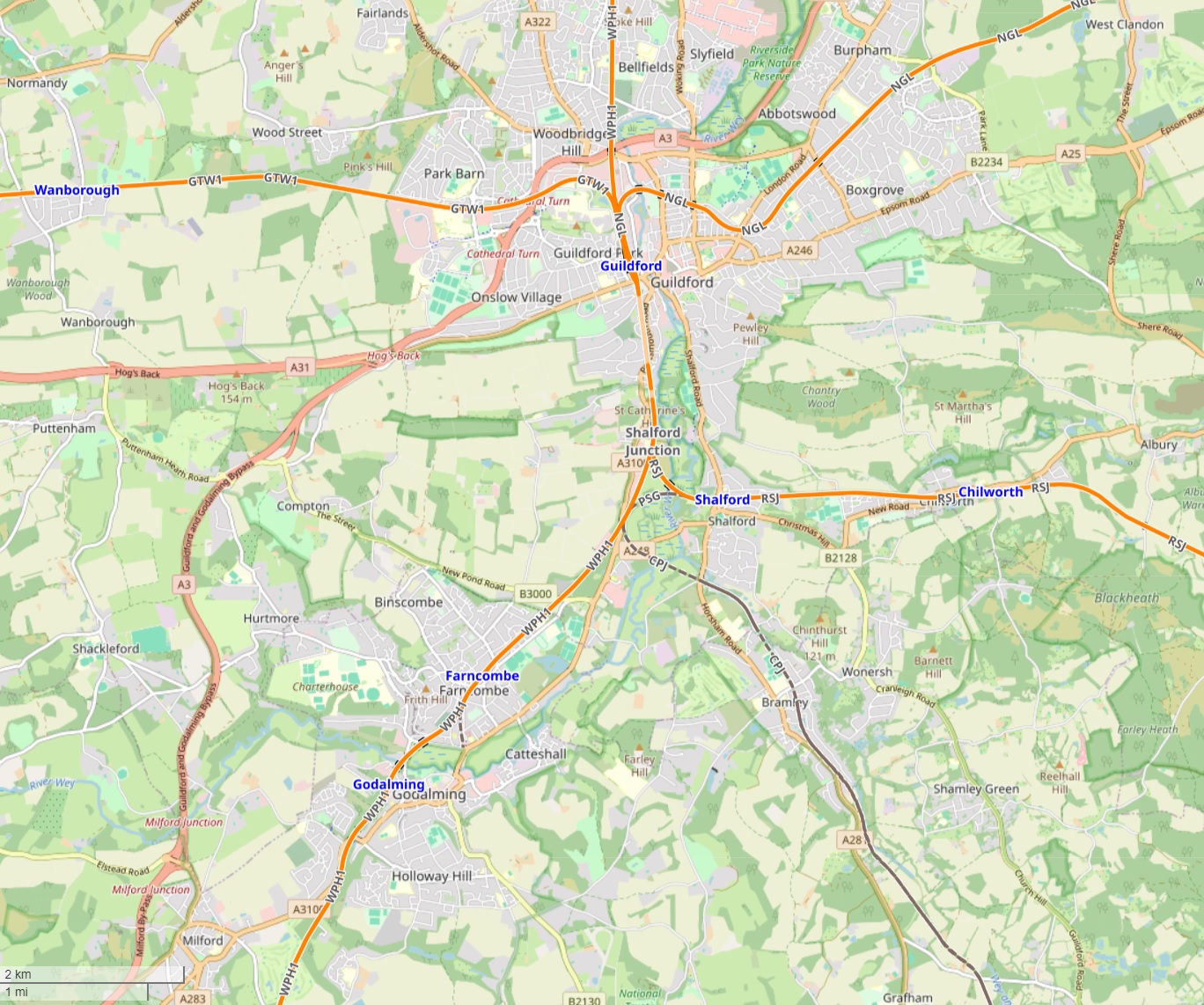
SHALFORD
Just south of Guildford lies Shalford Junction. Trains from Gatwick, Redhill, Dorking Deepdene can currently only head north to Guildford. A rebuilt bridge over the River Wey and re-railed curve could route trains towards Godalming and Portsmouth but also on to a re-built Cranleigh and Horsham line.
Mapping by openrailwaymap.org
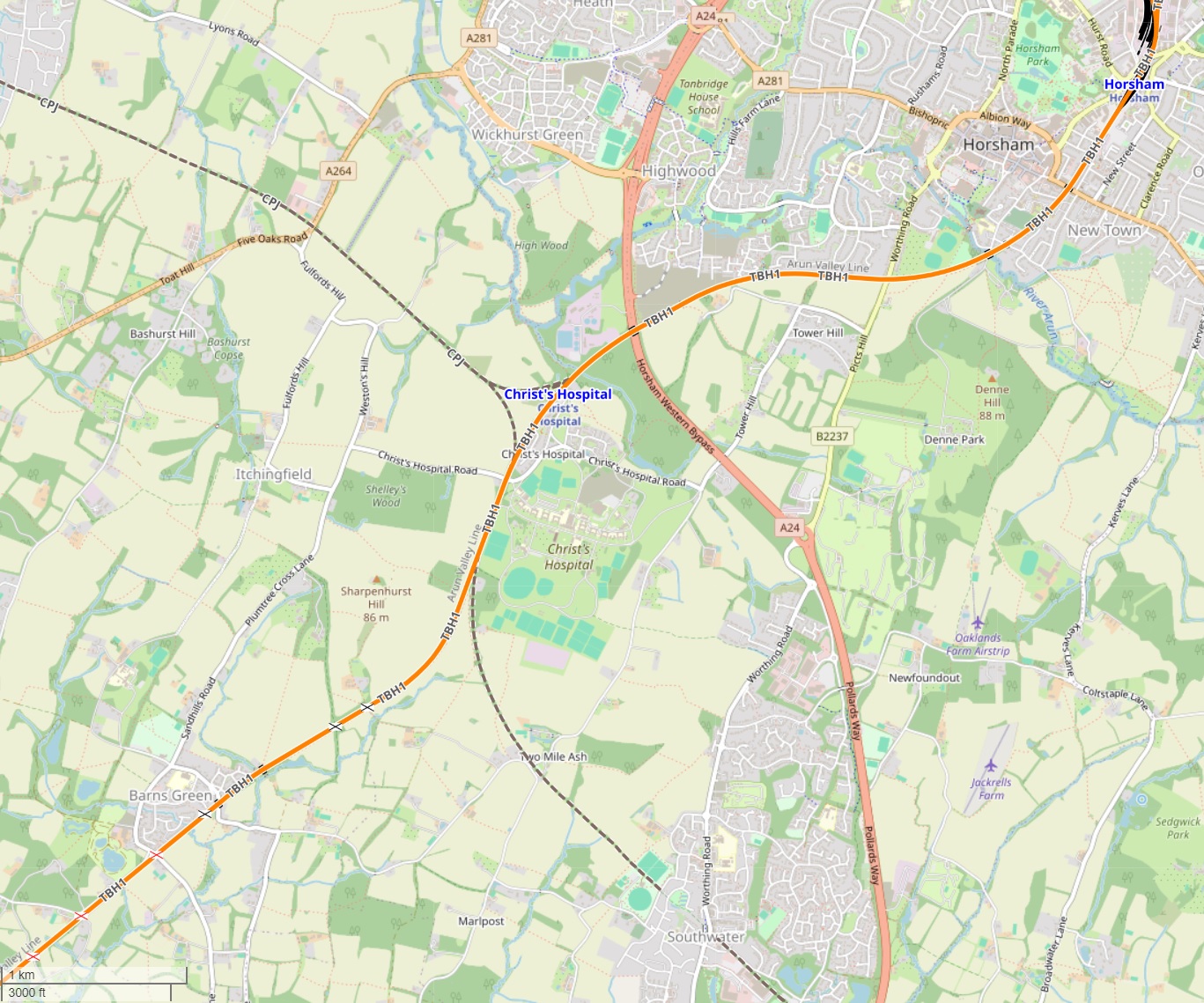
Christ’s Hospital
The south-western conclusion of a re-built Cranleigh line would be a junction at Christ’s Hospital. We’re calling for both original curves to be re-railed – smoothly relinking to the east for Horsham and on to Three Bridges and to the south-west for Arundel and Littlehampton.
We’re acutely aware that a future Steyning line rebuilt to modern specification would necessitate a new direct rail flyover bridge over the Horsham – Arundel line at Christ’s Hospital.
Mapping by openrailwaymap.org
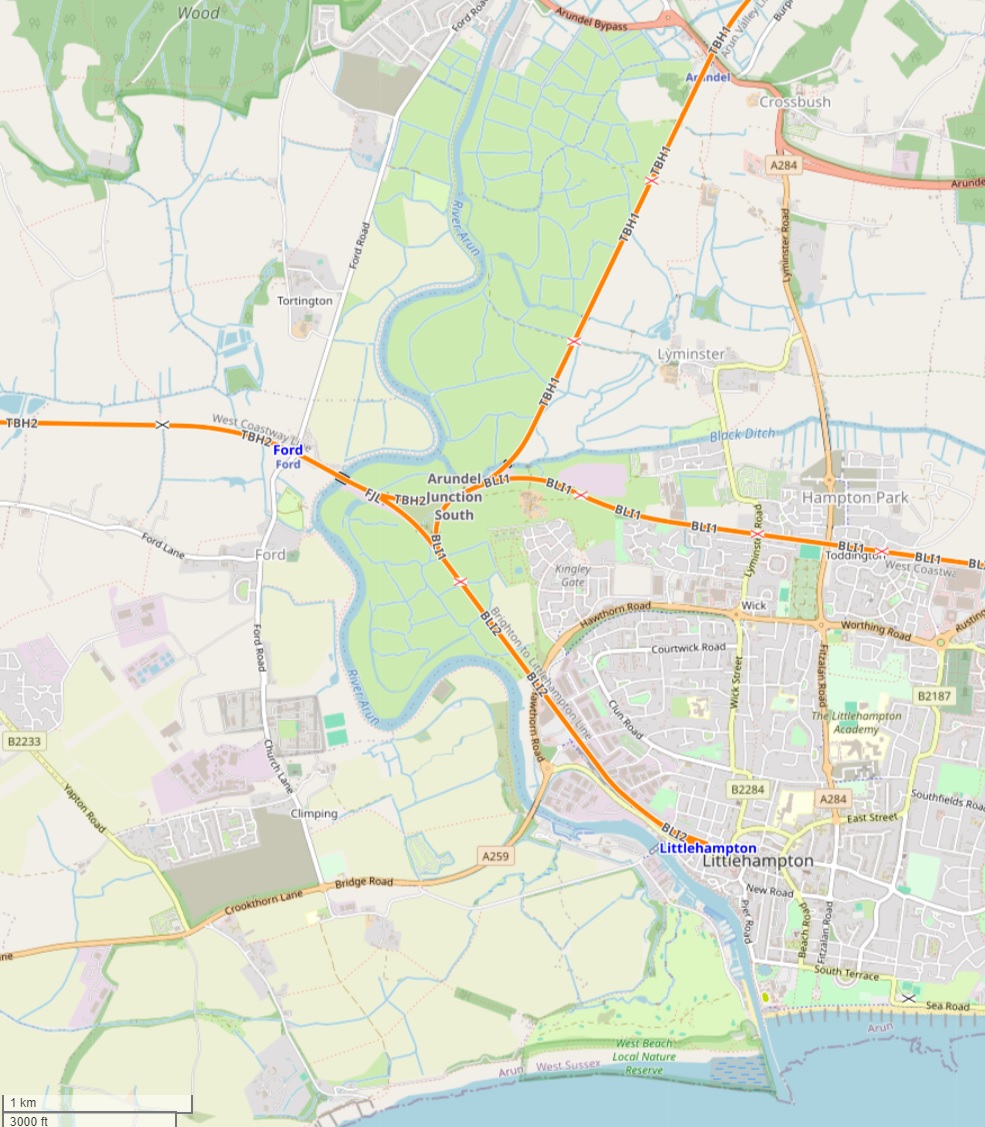
Arundel Junction
Finally, Arundel Junction curve. It’s an easy win. A curve should be built linking the Mid-Sussex Line from Horsham and Three Bridges with the West Coastway Line east to Worthing and Brighton. It could offer interim direct access from Horsham to Shoreham-by-Sea and Brighton for both passenger and freight usage.
Mapping by openrailwaymap.org
THE LONG VIEW
“Instant” is not a word for projects such as this! They are incremental and formed in a context of some hostility to rail re-openings, both within and outside the rail industry and government itself.
For example, the Office for Road and Rail (ORR) has a policy against level crossings for re-openings, demanding expensive bridges and duck-unders. Costs inevitably rise and are disproportionate when evidence exists to indicate that level crossings can be an entirely safe, cheap and useful alternative. Balance is needed to prevent costs spiralling and deterring sound ideas and a long term modal shift back to rail.
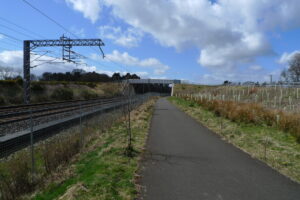
It’s also been proved that cycle-ways making use of former railway corridors can be retained and enhanced whilst sharing space with re-railing projects. Yes, opposition can be strong and persuasive but the bigger environmental picture must be kept in view.
The Cycling Scot cyclingscot.co.uk
WORKING ALONGSIDE THE NORTH DOWNS LINE
Our vision for Cranleigh re-railing means that the role of the North Downs Line is not undermined – it’s doing a roaring trade and it’s crucial in the region. But it needs full third rail electrification.
We’re also campaigning for Thameslink services from East Croydon to run semi-fast via Redhill into Guildford. Potentially on to Reading. In turn, this would free diesel-powered units for strengthening reliability and offering additional services elsewhere.
BRTA is calling for protection from development for the full route corridor, considering realignment spaces where any blockages exist. This re-opening may involve a bypass of built environments and new parkway-style stations in some cases at Horsham and Shoreham. Zones should be ringfenced from encroachment and included in planning decision-making.
A detailed study into the business case, necessary engineering, cost, environmental benefits / impact must now be made.
We recognise that cycle ways and footpaths are a vital leisure facility for many – considering both physical and mental wellbeing. Re-railing planning must embrace the philosophy of “green corridor” sharing with fence divided spaces, limited and minor updates to cycle routes whilst ensuring the railway can take the trackbed priority for double-track solutions.
We are pressing councils, public agencies and other tiers of power to see the strategic gains the rebuilt railway offers, notably regeneration on the South Coast. We’re highlighting the potential of port rail service from Shoreham-by-Sea, providing sustainable expansion and bringing jobs and new trade.
Above all, we need local support, expressed in BRTA membership, volunteering and campaigning, to make progress from grassroots upwards and outwards, making the strategic case that the line would play in a nationwide rail network.
Roger Carpenter CC BY-NC 2.0
HOW TO ADD YOUR VOICE
Write in support of reopening to your local councillors and MP:
It’s powerful to write to your MP or councillor in your own words, telling your representative about your own beliefs and experiences and how they relate to this area. See below.
Join BRTA as a member to support these and other reopening campaigns
Volunteer with BRTA if you share our vision and want to help bring it about.
Could you help push this campaign forward?
Donate to BRTA to help us advocate for a rail link fit for the 21st century!
Think about the following questions when composing your letter to MPs / councillors:
What journeys do you make? Work? Leisure? Appointments / visits? How could this link improve the journeys you make?
Do you actively choose road over rail or bus? Why?
Do you consider where you live to be well served by public transport?
Do you have experience of new areas of housing and public transport?
What are your experiences of the road journeys you make in the region?
Have you made employment, school or relocation decisions based on journey times or access to public transport? Or on the lack of access to public transport?
What are your thoughts on the environmental impact of your journeys?
Do you have accessibility needs that affect journey decisions you make?
What do you think about air pollution in your area?
What are the most important transport related issues to you? Why? Journey times? Road congestion reduction? Pollution reduction? Accessibility? Taking freight off the roads in your area? A better connected region?
What should be done next to make this happen? Our tips:
Even if your MP is not in this region, your letter provides them with an opportunity to learn about the issue and take action themselves.
Aim for your letter to be no longer than one and a half sides of A4.
Engage. Get your representative’s attention with a dramatic fact or short statement.
State the problem. Present the causes of the problem you just introduced. How widespread or serious is the problem?
Inform them about the solutions that reopening would bring.
Call to Action. Let them know what you want them to do about it.