Welcome to British Regional Transport Association: Sustainable Britain Needs Re-Railing
Menu
Re-Rail Woodhead
Reconnecting the Missing Trans-Pennine Railway
Protect the route. Build the coalition. Develop the business case. Deliver a modern Woodhead Railway fit for the 21st century.
rail Network capacity and resilience
Regenerating local economic growth
Reconnecting communities, enhancing accessibility and inclusion
Reducing road congestion and pollution, improving our environment
promoting quality of life and health
A Strategic Railway for the 21st Century
The former Woodhead route remains one of the most significant missing rail corridors in Britain.
For more than forty years, the loss of the railway between Sheffield and Manchester via Woodhead has left a major gap in the national network. During that time road traffic has grown, freight volumes have increased, congestion has worsened and pressure on existing rail routes has intensified. Meanwhile the former railway corridor continues to demonstrate the potential value of a restored strategic east-west rail link.
BRTA believes it is time to revisit the case for a modern Woodhead Railway designed for today’s transport challenges and tomorrow’s opportunities.
Mapping by openrailwaymap.org
More Than Manchester to Sheffield
The Woodhead campaign is often portrayed simply as a proposal to improve travel between Manchester and Sheffield.
That misses the bigger picture.
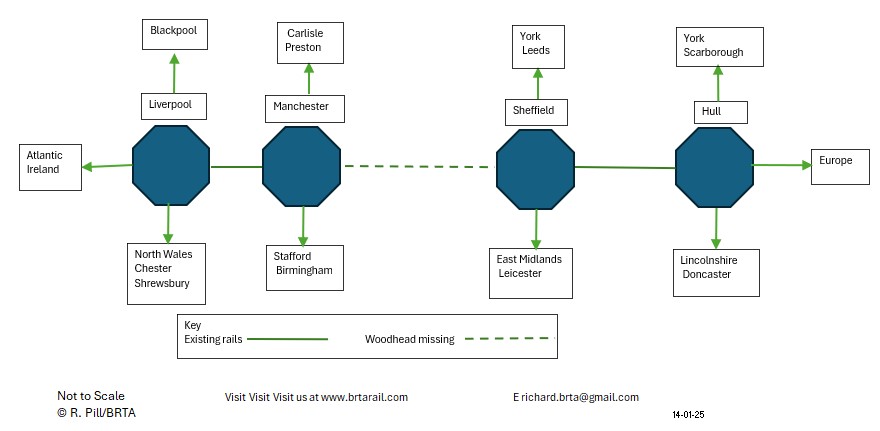
A rebuilt Woodhead route would serve as a strategic corridor linking:
Hull and Liverpool
Yorkshire and the North West
The North East and Greater Manchester
Lincolnshire and North Wales
Ports, freight terminals and distribution centres across northern England
Rather than serving a single journey market, Woodhead would create a network effect across multiple regions, strengthening the resilience and capacity of Britain’s railway system.
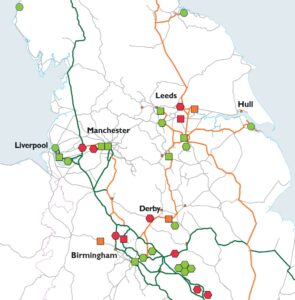
DfT England's Port Connectivity Report 2018
Roger Carpenter CC BY-NC 2.0
Supporting Sustainable Growth Through Rail
The UK has declared a climate emergency and transport remains one of the largest contributors to emissions.
The challenge is not simply moving people faster. It is moving more people and more goods sustainably.
A restored Woodhead route would:
Offer greater modal choice.
Reduce dependency on congested roads.
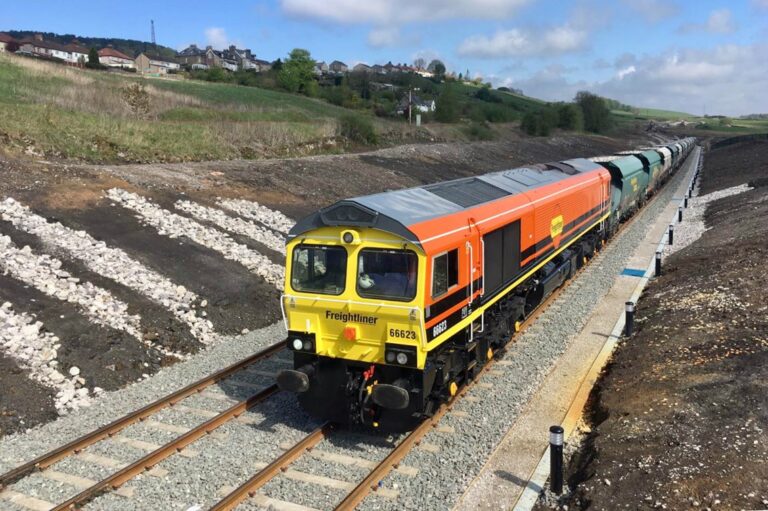
Provide additional freight capacity.
Support sustainable economic growth.
Create opportunities for communities currently underserved by rail.
Rail is uniquely capable of moving large volumes of passengers and freight efficiently using a single corridor. Every freight train removes significant numbers of lorries from roads, reducing congestion, emissions and infrastructure wear.
A Freight Railway for the Future
The original Woodhead route was heavily associated with coal traffic.
A modern railway would serve very different markets.
Future freight opportunities include:
Intermodal containers.
High-cube container traffic.
Parcel and logistics services.
Palletised distribution.
Swap-body operations.
Potential future piggyback and roll-on/roll-off services.
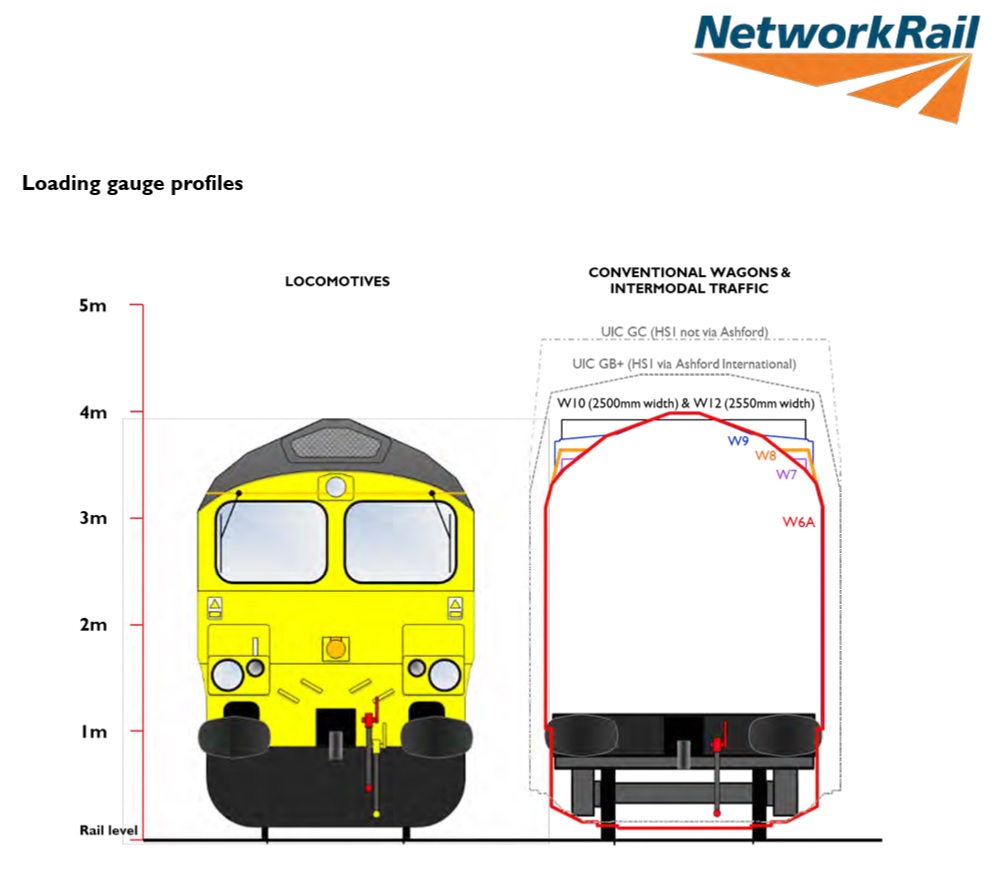
A rebuilt Woodhead line should be designed to modern W12 freight loading gauge standards, allowing efficient movement of 9’6″ high-cube containers and future-proofing the route for changing logistics requirements.
At present there is no trans-Pennine rail corridor fully designed around these future freight needs. Woodhead presents a unique opportunity to address that gap.
Network Rail
Network Rail
Jon David Houghton, CC BY-SA 4.0
Complementing Northern Powerhouse Rail
Woodhead should not be viewed as an alternative to Northern Powerhouse Rail or other major investment programmes. Instead, the schemes can work together.
Since the preferred NPR alignment focuses on the Manchester-Leeds-Bradford corridor, much of the Manchester-Sheffield axis remains underserved by future proposals.Woodhead offers an opportunity to fill that gap.
Likewise, capacity released through wider rail investment could help accommodate services running through Manchester, strengthening the case for reopening Woodhead.
The question should not be “Woodhead or NPR.” The question should be: “How can northern rail investment work together to maximise benefits for passengers, freight and communities?”
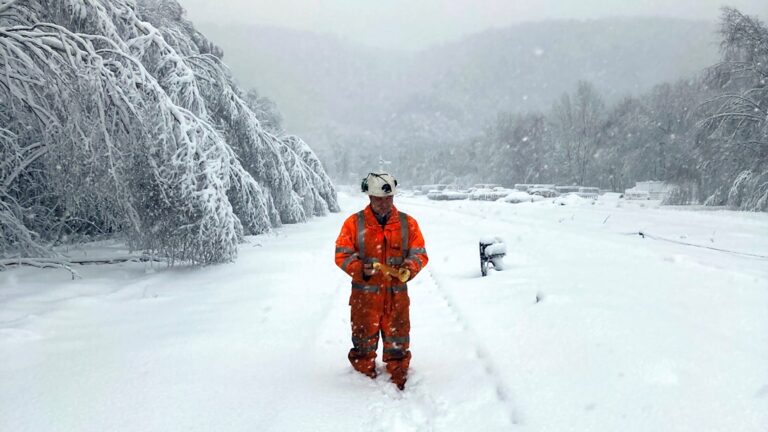
When severe weather, engineering works or infrastructure failures affect one route, trains can be diverted via another.
Recent experience elsewhere on the network has highlighted the value of parallel routes in maintaining railway reliability.
Network Rail
Network Rail
The Importance of Resilience
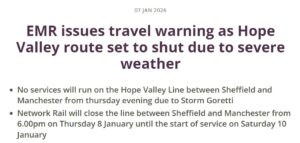
Resilience is increasingly important in transport planning. Today the Hope Valley route carries much of the rail traffic between Sheffield and Manchester.
When disruption occurs there are few alternatives. A rebuilt Woodhead route would provide:
Operational resilience.
Diversionary capability.
Additional capacity.
Reduced dependency on a single corridor.
This mirrors the successful role played by parallel routes elsewhere in northern England.
A New Tunnel for a New Era
BRTA recognises that a modern Woodhead railway would require significant engineering works.
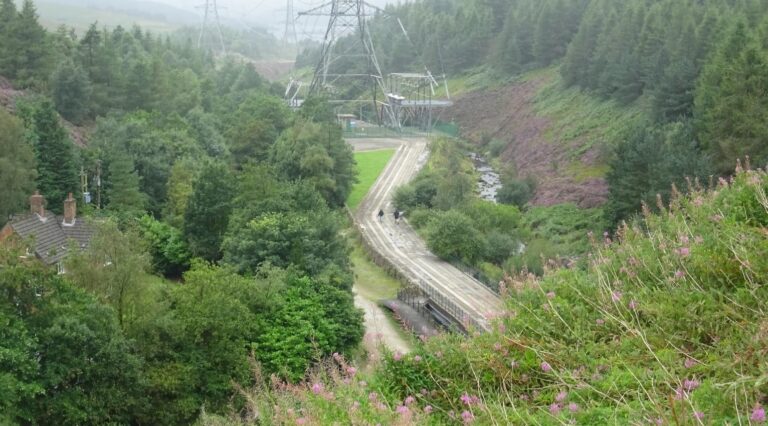
The centrepiece of any reinstatement would likely be a new tunnel designed to modern standards rather than attempting to reuse historic infrastructure inappropriately.
The debate should not focus on whether Woodhead is a “reopening” or a “new railway”. Successful transport schemes are almost always a combination of:
Reused corridors.
New infrastructure.
Modern standards.
Future-proofed design.
David Frankal
A Gateway to the Peak District
A modern Parkway-style station at Woodhead could become a sustainable transport gateway into the Peak District National Park.
Rather than encouraging ever-increasing road traffic through sensitive landscapes, rail could provide:
Visitor access.
Reduced parking pressures.
Lower emissions.
Sustainable tourism growth.
With thoughtful design, rail infrastructure and environmental protection can work hand in hand.
Peter McDermott CC-BY-SA-2.0
Working With Other Reopening Campaigns
Woodhead does not stand alone.
BRTA sees opportunities to align Woodhead with other strategic reopening projects, including:
Harrogate – Ripon – Northallerton
York – Beverley – Hull
Peak Rail’s Derby – Matlock – Buxton – Manchester aspirations
Colne – Skipton
Together these projects could form a wider programme of rail restoration that improves network connectivity, provides alternatives to road travel and supports regional economic growth.
Before any railway can be rebuilt, the route must survive.
BRTA therefore calls for:
Protection of the remaining Woodhead corridor.
Further technical and economic study.
Formation of a trans-Pennine stakeholder consortium.
Development of modern engineering options.
Integration with wider regional transport planning.
The longer action is delayed, the greater the risk of further route loss and increased future costs.
David Frankal
The Opportunity
Woodhead is not about nostalgia.
It is about capacity.
It is about connectivity.
It is about resilience.
It is about creating a railway capable of carrying passengers and freight across the Pennines whilst supporting regional growth, reducing pressure on roads and helping Britain meet its environmental objectives.
A modern Woodhead Railway would not simply restore a lost line. It would create a strategic transport asset for future generations and help build a more connected, sustainable and resilient North of England.
Network Rail
HOW TO ADD YOUR VOICE
Write in support of these ideas to your local councillors and MP:
It’s powerful to write to your MP or councillor in your own words, telling your representative about your own beliefs and experiences and how they relate to this area. See below.
Join BRTA as a member to support this and other reopening campaigns.
Volunteer with BRTA if you share our vision and want to help bring it about.
Could you help push this campaign forward?
Donate to BRTA to help us advocate for rail links fit for the 21st century!
Think about the following questions when composing your letter to MPs / councillors:
What journeys do you make? Work? Leisure? Appointments / visits? How could this link improve the journeys you make?
Do you actively choose road over rail or bus? Why?
Do you consider where you live to be well served by public transport?
Do you have experience of new areas of housing and public transport?
What are your experiences of the road journeys you make in the region?
Have you made employment, school or relocation decisions based on journey times or access to public transport? Or on the lack of access to public transport?
What are your thoughts on the environmental impact of your journeys?
Do you have accessibility needs that affect journey decisions you make?
What do you think about air pollution in your area?
What are the most important transport related issues to you? Why? Journey times? Road congestion reduction? Pollution reduction? Accessibility? Taking freight off the roads in your area? A better connected region?
What should be done next to make this happen? Our tips:
Even if your MP is not in this region, your letter provides them with an opportunity to learn about the issue and take action themselves.
Aim for your letter to be no longer than one and a half sides of A4.
Engage. Get your representative’s attention with a dramatic fact or short statement.
State the problem. Present the causes of the problem you just introduced. How widespread or serious is the problem?
Inform them about the solutions that reopening would bring.
Call to Action. Let them know what you want them to do about it.
Ask for a response.
We’re campaigning for better public transport. Join us.
stimulating economic growth enhancing accessibility and inclusion
promoting quality of life and health improving our environment